Hiển thị các bài đăng có nhãn animals. Hiển thị tất cả bài đăng

Thứ Tư, 16 tháng 11, 2016

Some of the most amazing Meerkat facts

Right here in this article, you can learn about all your favourite animals, and even some you may have never heard of some of the most amazing Meerkat facts


1. THEY RECOGNIZE EACH OTHER’S VOICES


Just as humans can identify our friends’ and family’s voices over the phone, a 2011 study showed that meerkats can distinguish between the calls of different members of their clan. Scientists played a recording of the same meerkat from hidden speakers on opposite sides of test animals. According to WIRED, "The situation was similar to hearing a friend shout from the kitchen, then from the second-floor bathroom just a second later." Indicating that they recognized this as an impossible situation, the test meerkats showed “a prolonged vigilance, paying much closer attention than they did to other recorded calls. The situation didn’t compute.”

2. THEY WORK TOGETHER ...

Meerkat clans, also known as mobs and gangs, hunt together in a collaborative effort that involves designated lookouts who rotate regularly and rely on a series of distinct calls to communicate to their compatriots. If a predator like a snake is detected, the gang will gather to harass the snake, biting and clawing at it until it retreats or is killed—a bold move one meerkat could never attempt alone.
Enjoy our wide range of funny pictures with captions that can make a joyful day.

3. ... AND EVEN BABYSIT EACH OTHER’S PUPS.


While most of the gang is out foraging and hunting for food—or standing guard—one male or female, adolescent or young adult stays behind in the burrow to “babysit” any pups. This is not an official job—whichever adult is least hungry is put on pup-sitting duty—but the other meerkats do reward their sitter with food at the end of the day.

4. THEY TEACH THEIR YOUNG.

Adult meerkats are immune to scorpion poison—a good thing when you regularly make treats out of the stinging arthropods. But it takes talent to tuck into that sort of prey—even with their poison nullified, a scorpion can still do damage with his pinchers—and pups aren’t born prepared for such a vicious meal. Research done in 2006 showed that “helper” meerkats actively teach the younger generation how to hunt through a series of increasingly difficult tasks. "So when pups are very little they get brought dead prey, like scorpions, lizards, and spiders; as they start to get older, helpers will bring them prey that's been disabled, so if it's a scorpion the helper might bite the sting off before giving it to the pup,” scientist Alex Thornton told the BBC.

5. GANGS ARE MATRIARCHAL.

Meerkat gangs, which can reach up to 40 or 50 animals, are structured around an alpha couple to whom most of the other members are somehow related. Within the dominant pair, ultimately it is the female who rules the burrow, and she isn’t always a benevolent boss. Only the alpha female is allowed to reproduce; if subordinate females get pregnant, the alpha female will banish them from the burrow or even kill their pups. Research conducted in 2013found that some subordinate females will serve as wet nurses to alpha female pups in order to re-ingratiate themselves after getting banished. Anyway, this may be one of the most fascinating animal facts until now

6. MATRIARCHS ARE REALLY REALLY SELFISH


As if infanticide and exile weren’t bad enough, alpha females only have their own interests at heart. A 2013 study showed that when a gang of meerkats approaches a road—which represents an unknown and potential danger—alpha females tend to suddenly fall back, letting lower ranking females brave the pavement first.

7. THEY USE THEIR BELLIES TO KEEP WARM.

Meerkats' fuzzy tan coats give way to a sparsely covered patch on their underbellies [PDF]. The hair is thin enough there that you can see their black skin underneath—which is precisely the point. After a restful night in the chilly burrow, meerkats climb back out into the desert sun and stand up to expose to their bare bellies to the rays, which absorb heat and warm the animals up.

8. THE FORKED-TAIL DRONGO MIMICS MEERKAT CALLS.

The African drongo scavenges for food by tricking other animals into abandoning their hard-earned meals with carefully crafted calls that imitate the warning sounds of other species. So after a gang of meerkats has made their kill or foraged sufficient food, the drongo will descend among them and mimic the same warning call a meerkat sentry might make in the event of a predator. The gang scatters, and the drongo gets a free meal.

Those who loves to discover nature will not want to miss our wide range of factoflife articles.

Thứ Ba, 15 tháng 11, 2016

Open your mind with Jaguarondi facts

Open your mind with Jaguarondi facts

Jaguarondi (jaguarundi) is a species of wild cat that resembles large otter in appearance. Because of that, it is also known as otter cat. Jaguarondi lives in Southern parts of North America, Mexico and South America. 


There are 8 subspecies of jaguarondi that can be found in wide variety of habitats: tropical rainforests, savannas, semi-arid areas, woodlands and swamps. Number of jaguarondis in the wild is decreased for several reasons. Farmers kill jaguarondis because they hunt and feed on their poultry. Jaguarondis often end up trapped in the nets set for other animals. Finally, habitat loss greatly reduces number of jaguarondis in the wild. Despite all this, jaguarondis are not listed as endangered species.
  1. The jaguarundi is a very unusual cat that is often described as having a weasel-like appearance. It has a long slender body, short legs and a small flattened head with short rounded ears, the cat is often described as.
  2. Sometimes referred to as the ‘otter-cat’, the jaguarundi is closely related to the puma.
  3. One of the smaller New World cat species, they are about twice the size of a small house cat. Jaguarundis are unusual as they do not have spots, unlike most other South American small cats. This might be one of the most amazing facts about animals ever seen
  4. Jaguarundis are very elusive animals and there is still a lot to be learnt about them.
  5. Population numbers of the jaguarundi are much less than once thought. They live in very low densities and their shy nature makes it difficult to estimate their population size. Overall the population is in decline due to habitat loss to agriculture.
  6. They have some of the most variable colourations of wildcats, with two main groups: a dark morph which includes cats with black, brownish and grey colours, and a paler red morph ranging from tawny yellow to a bright chestnut red.
  7. For many years, it was thought the two morphs were separate species but it is now known that both colours can occur from the same litter.
  8. Generally, it seems the darker morph is more common in rainforest habitats and the paler morph in drier environments.
  9. Unlike most other cat species, the jaguarundi tends to be most active during daytime rather than dawn or dusk.
  10. Jaguarundis are very vocal cats, with at least 13 distinct calls that include chirps, purrs, whistles and even a scream.
  11. Choosing to spend more time on the ground than many other big cat species, the jaguarundi tends to hunt small mammals, birds and reptiles on the ground. They have also been witnessed to jump as high as two metres off the ground to swipe a bird from the air!
  12. Jaguarundis have very large home ranges. Some males were recorded as having a range from 88 to 100km2! Females tend to have much smaller ranges – varying from 13 to 20km2.
  13. The Texan population of jaguarundis may now only consist of a few remaining cats. Habitat loss has caused this population decline. Let’s discover some interesting science facts that will amaze you.
  14. In parts of North America there have been some reintroduction efforts but these are hindered by the lack of scientific knowledge about the animal, its needs and behaviours.
  15. The breeding behaviour is not well known; scientists are unsure whether jaguarundis raise cubs alone or as a pair. Females will have between 1-4 young which remain in the den for around 28 days.
  16. The jaguarundi are not hunted for their fur like many other cats but they will often be caught in traps set for other animals such as the ocelot.
You can also subcribe our factoflife if you want to find out more about animals and nature for kids.

Thứ Năm, 6 tháng 10, 2016

7 interesting facts about light and shadow for kids

Check out amazing facts about shadow below:

  • A shadow happens when an object blocks the sun’s rays. Shadows are longer in the winter because of the angle of the sun.
  • Your shadow is longest in the early morning and in the late afternoon. In the afternoon, when the sun is directly above you, your shadow leaves your side for a little while. The sun makes the longest shadows at the beginning and at the end of the day because at that time, the sun is lowest in the sky and aimed at the sides of the various things on the earth. When the sun is directly above you, there is little or no shadow because the light from the sun is falling upon you from all the sides and there is hardly any dark region.
  • A long time ago, people observed the way shadows were formed by the sun and utilized this principle in making the world’s most primitive clocks, the sundials.
  • The first person to calculate the size of the planet Earth with a high degree of accuracy used simple geometric equations and measurements of shadows. Eratosthenes, the head librarian of the Great Library of Alexandria, performed this feat over 2,000 years ago, around 250 BCE.
  • Does everything has a shadow? Take a look around and see what all things form shadows. You will notice that swings, trees, cars, tables and almost everything else has a shadow. Any object – living or non living that can block light can cast shadows.
  • Is there anything that doesn't have a shadow? Some objects, such as glass, are transparent. Light can shine through them. Some light shines through translucent objects, such as a balloon or sheet of wax paper. Light cannot shine through opaque objects and you can’t see through them. Opaque objects, including a desk, bath towel or blanket, are solid.
  • The smaller the angle between an elongated object and the direction of the light is, the shorter the shadow is. On the other hand, the smaller the angle between the direction of the light and the surface on which the shadow occurs is, the longer the shadow is.
  • If the object is close to the light source, the shadow is large. 
  • If the surface is curved there are further distortions.
  • For non-point sources of light, the shadow is divided into the umbra and penumbra. The wider the light source, the more blurred the shadow.
  • If there are multiple light sources there are multiple shadows, with overlapping parts darker. For a person or object touching the surface, like a person standing on the ground, or a pole in the ground, these converge at the point of touch.

Check out for more news about animal facts and about tiger facts for kids.

Thứ Tư, 10 tháng 8, 2016

What happened if you grew up with cats?

Are you wondering what are the most interesting animal facts, here is the right place to answer your puzzle. Here are some amazing struggles with cats when you grew up with them:

1. The tragedy of accidentally stepping on their paw.
2. Cleaning their litter box and wondering how one cat can shit that much.


3. Having intelligent conversations with your cat in order to get things off your chest.
Just finally, and belatedly, had the conversation about systemic racism with my cat. If her solemn meows are any indication, she's not happy
4. Feeling hella sad when they’re in the way sleeping and you have to move them.
5. Or giving up entirely and letting them dictate when and where you can go.
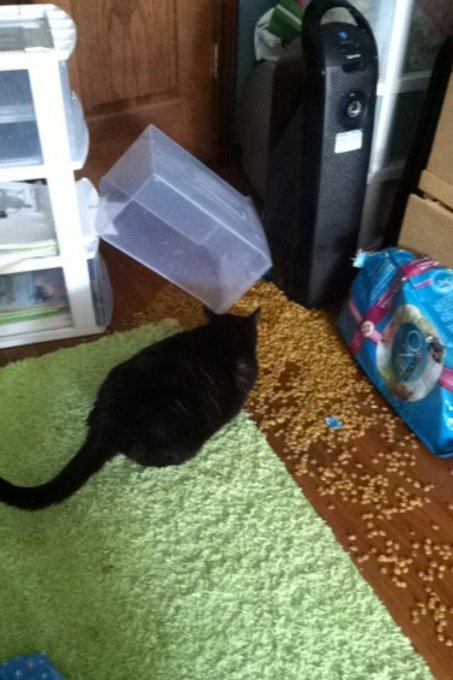
6. Leaving for just two seconds and coming back to this.


7. Having to buy new headphones every few months because your cat chewed through them.


8. When they bring dead animals to your front door and just…leave them there.